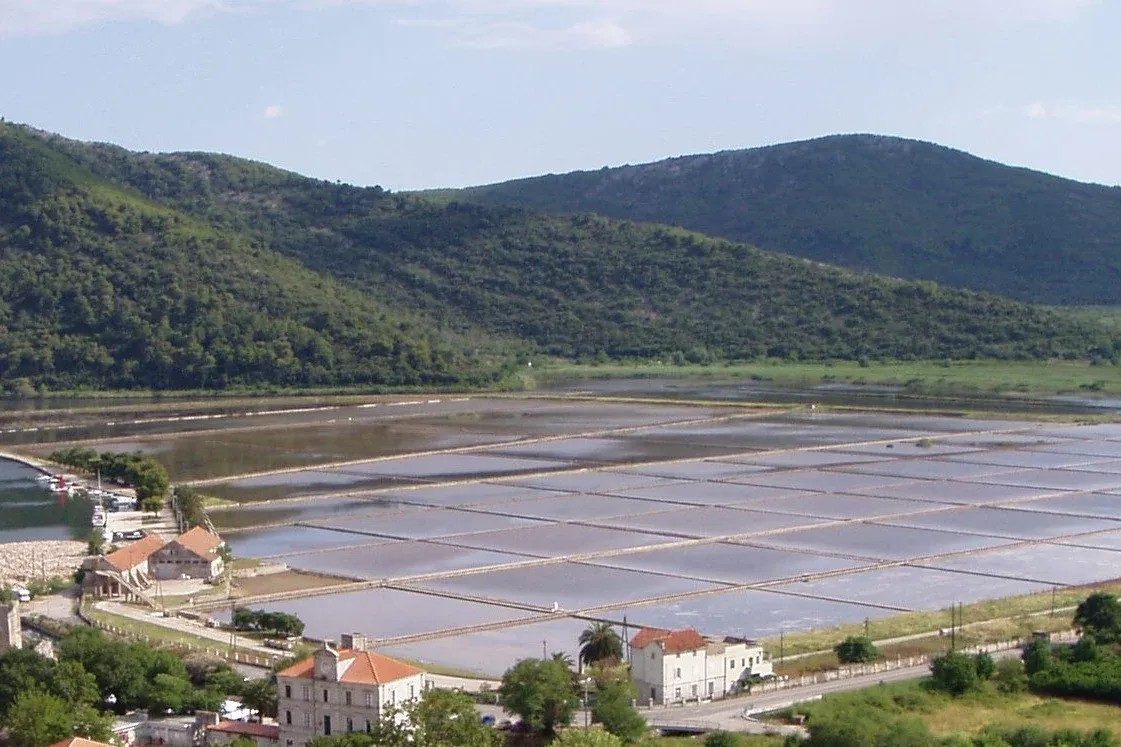
The Ston Salt Pans on the Pelješac Peninsula
The Ston salt pans lie beside the town of Ston on the Pelješac peninsula in Croatia. According to the Ston tourist board, salt is still made here from seawater using the sun, the wind and human labour. As of 13 October 2026, "Ston salt" is not a protected designation of origin, and Ston is on UNESCO's Tentative List, not on the World Heritage List.

Where the salt pans are
The operator of the saltworks places the pans between the fertile Ston field (Stonsko polje) and the deep Ston bay, right next to the small town of Ston. The operator also mentions the short isthmus that joins the Pelješac peninsula to the mainland. The saltworks, called Solana Ston in Croatian, is one of three saltworks in Croatia, according to the tourist board. Ston and Mali Ston are about a kilometre apart by car, or roughly a 40-minute walk along the walls, and both belong to the Ston–Ponikve area.
The tourist board writes that the saltworks is divided into basins. Each one except Mundo, the basin "for the people", bears the name of a Christian saint, for example Sv. Frano, Sv. Petar i Pavao, Sv. Vlaho or Sv. Nikola. According to the operator, salt from Mundo was given out under the Republic of Dubrovnik to people in the area who had no money to buy it.
The operator's statements on this page are taken from copies of its website archived on 4 August 2025: the Povijest page, the Donacije page.
History of the saltworks
According to the tourist board, the Republic of Dubrovnik bought Ston in 1333 and enclosed it with a defensive wall in 1360. The Croatian Encyclopedia (Hrvatska enciklopedija, Miroslav Krleža Institute of Lexicography) adds that Ston passed to the Republic together with Pelješac in 1333 and that its importance rested on its saltworks, where salt was already extracted in the Roman period. The operator gives Stagnum as the name of the settlement of Ston. According to the register of cultural goods of the Croatian Ministry of Culture, the people of Dubrovnik built the whole fortification complex between 1333 and 1506, and they founded Mali Ston in 1334.
The tourist board writes that a defensive rampart across the peninsula was built first, over a period of about thirty years, together with two fortified towns laid out to a single plan: Ston in the south and Mali Ston in the north. They were meant to bring people together to guard the border and to work in the saltworks. A separate fortress, Veliki kaštio, was built to protect the Ston saltworks, according to the tourist board.
Under the Republic, salt became a state monopoly and a special salt office was set up in the town, according to the Croatian Encyclopedia. The operator calls Ston salt a monopoly product of the Republic. The tourist board writes that salt production, transport and trade held an exceptionally important place in the economic life of the Republic, and that the Republic and its authorities looked after the Ston saltworks until the Republic ended in 1808.
Šime Peričić traced the history of the saltworks up to the Second World War in a study published in Anali Dubrovnik in 2005. According to its abstract, the saltworks was important for centuries to the livelihoods of the people of Ston and the surrounding area.
How the salt is made
The tourist board says that sun, sea, wind and human labour still make the salt today, and that besides salt the saltworks produces fleur de sel. Under the Croatian salt regulation of 2019 (Narodne novine 70/2019), fleur de sel (solni cvijet) is a thin layer of fragile crystals that forms on the surface of concentrated seawater during traditional evaporation in crystallisation basins.
The operator states that the salt is obtained by evaporating seawater in large, shallow basins and that the whole process takes one to two months, depending on the weather. In its account, the complex also includes areas for drying and storing the salt and for carrying it to the old port of Ston, from where sailing ships took it around the world at the time. About 500 tonnes of salt are harvested here each year, according to the operator (copy of its page archived on 4 August 2025); other sources give different amounts.
What is protected and what is not
The facts in this section were checked on 13 October 2026.
| List or register | Entry |
|---|---|
| UNESCO World Heritage List | Ston is not among the ten Croatian properties |
| UNESCO, Croatia's Tentative List | since 2005: the historic ensemble of Ston with Mali Ston, the connecting walls, the Mali Ston Bay nature reserve, the Ston field and the salt pans |
| Ministry of Culture's register of cultural goods | the ensemble of Ston with its walls and fortifications (ZDU_191) and, separately, Mali Ston (RST-1274-1986); no separate record for the saltworks, and neither record mentions the salt pans |
| Natura 2000 (Narodne novine 80/2019, as amended by 87/2025) | the saltworks area is the site HR3000167 Solana Ston, a special area of conservation for species and habitat types |
| EU register eAmbrosia | "Stonska sol" is not a registered protected name; a search for "Ston" finds only one name associated with Ston, Malostonska kamenica, the Ston oyster |
| Croatian register of protected names (August 2026 update) | does not list Ston salt |
The Tentative List only records sites a country may decide to nominate. The missing record does not mean the saltworks is unprotected, only that the register does not name it. Paška sol from the island of Pag, by contrast, is a protected designation of origin (the European Commission's registration decision was published on 11 April 2019).
Visiting and the salt festival
The Ston tourist board publishes a ticket price list for tours of the saltworks and the opening hours on its website, ston.hr.
According to the tourist board, the Ston Salt Festival ran from 28 August to 15 September in 2025, and its tenth edition took place in 2026.
Frequently asked questions
- Where are the Ston salt pans?
- Beside the town of Ston on the Pelješac peninsula in southern Croatia.
- Is "Ston salt" a protected designation of origin?
- No. As of 13 October 2026, the name is neither in the EU register eAmbrosia nor in the Croatian register of protected names. Paška sol from the island of Pag is a protected designation of origin.
- Are the Ston salt pans on the UNESCO World Heritage List?
- No. The historic ensemble of Ston with Mali Ston and the salt pans has been on UNESCO's Tentative List for Croatia since 2005. That list is not the World Heritage List (as of 13 October 2026).
- How is Ston salt made?
- According to the operator, seawater evaporates in large, shallow basins, and the whole process takes one to two months, depending on the weather.
- How much salt do the pans produce?
- The operator gives about 500 tonnes a year (copy of its page archived on 4 August 2025).
- Can you visit the saltworks?
- Yes. The Ston tourist board publishes the ticket price list for tours and the opening hours on ston.hr.
Ston salt in the kitchen and in the book
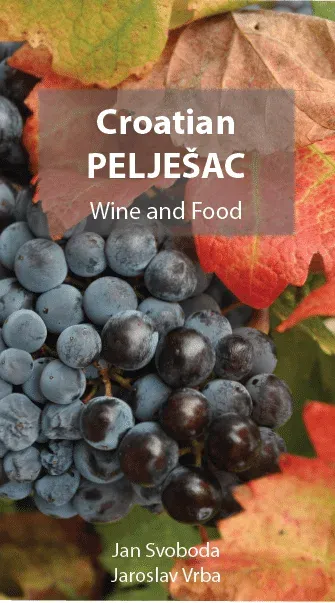
The recipe for sea bass in a salt crust uses coarse Ston salt. The food chapter of the book covers Ston salt, oysters, octopus, fish, the peka and wine with food.