The Pelješac Bridge in Croatia and the Road to Pelješac
The Pelješac Bridge crosses the Bay of Mali Ston in southern Croatia and carries the road from the mainland onto the Pelješac peninsula. Since it opened in July 2022, you can drive between Dubrovnik and the rest of Croatia without driving the stretch of about 9 km (6 miles) through Bosnia at Neum. We drive over it on every trip to Pelješac.
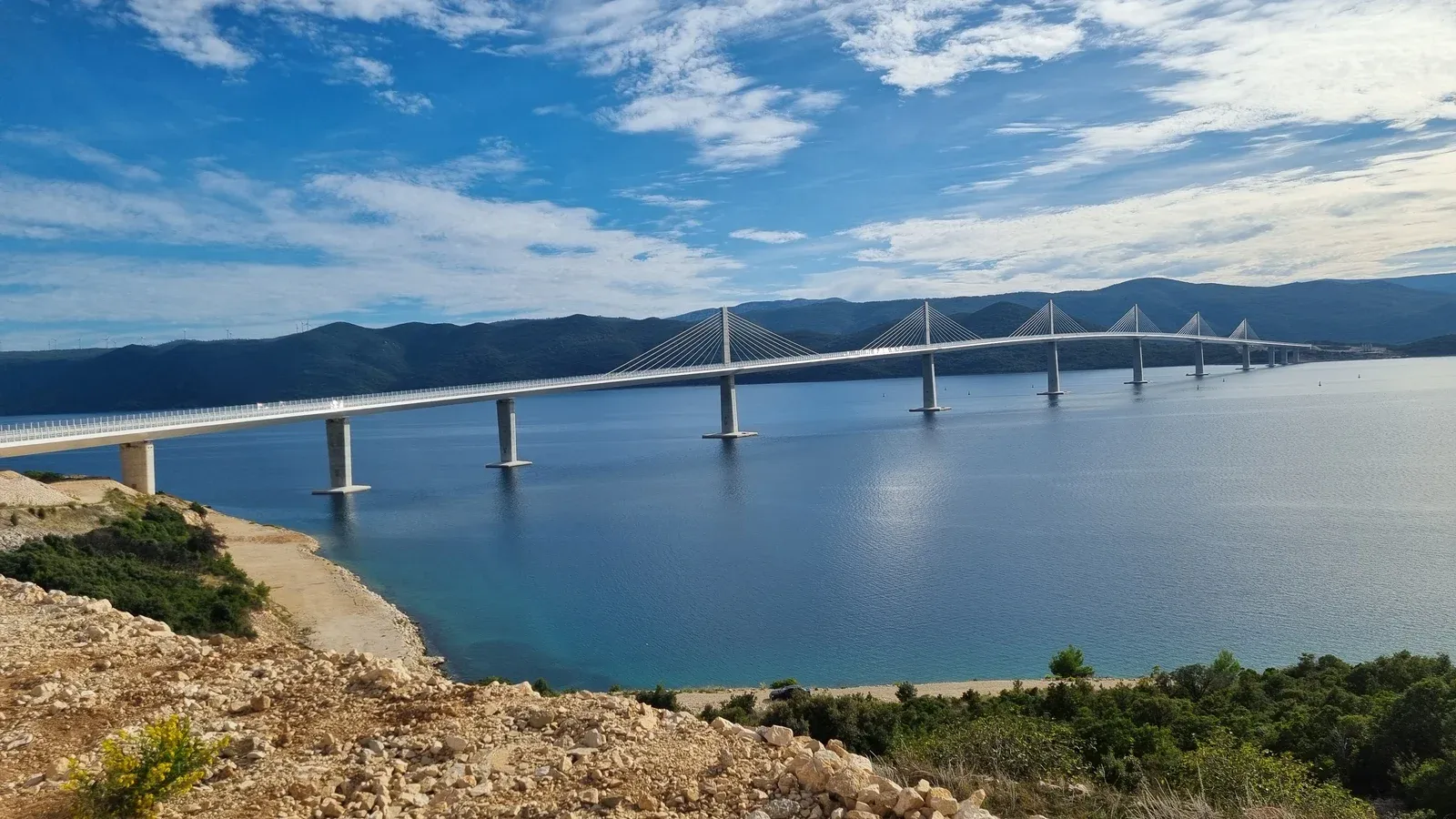
The Pelješac Bridge at a glance
| Figure | Value and source |
|---|---|
| Length | 2,404 m (about 1.5 miles) between the axes of the abutments, or 2,440 m including the abutments (Croatian Ministry of the Sea, Transport and Infrastructure, 28 July 2021) |
| Height for shipping | 55 m, raised from the 44 m first planned so that commercial ships can pass underneath (European Commission) |
| Main spans and pylons | five main spans of 285 m each and six pylons (Hrvatske ceste, the bridge owner) |
| Type | a multi-span extradosed cable-stayed bridge with an orthotropic steel deck (designer Ponting) |
| Design and construction | designed by Ponting, chief designer Marjan Pipenbaher; built by a consortium led by China Road and Bridge Corporation (CRBC) |
| Construction | contract signed on 23 April 2018 (government); works officially began on 30 July 2018 according to Hrvatske ceste, or 31 July 2018 according to the ministry; the last deck section was joined on 28 July 2021 |
| Opening | ceremony in the evening of 26 July 2022; open to traffic from midnight (HRT) |
| Cost | 526 million euros including VAT for the whole project, with eligible costs of 420 million euros (ministry, 2021); the project covers the bridge, the access roads and the Ston bypass. The EU contributed 357 million euros (European Commission). The Commission's opening article calls the 420 million euros the construction cost. |
Where sources give different figures, both are listed with the source and what each figure measures.
Is there a toll on the Pelješac Bridge?
When the bridge opened, the European Commission, which co-financed it, wrote that it "guarantees safe and toll-free access for all motorized transport" (27 July 2022; statement checked on 21 October 2026).
Getting to Pelješac without crossing Neum
Before the bridge, the coast road to Dubrovnik ran through about 9 km (6 miles) of Bosnian territory, the Neum corridor. According to the European Commission, the bridge route spares drivers two customs controls in less than 10 km (6 miles) and cuts the travel time by more than half. In the Commission's figures, the travel time on the coast road between the points either side of that stretch drops from 59 to 22 minutes.
The old coast road is still there, with a border crossing at each end. The Ministry of the Interior says that Croatia joining the Schengen area changed nothing for crossing the external border, where everyone is checked systematically on entry and exit.
Access roads and the Ston bypass
Hrvatske ceste built a rest area at each end of the bridge: Komarna on the mainland side and Blaca on the Pelješac side. It lists 2.14 km (1.3 miles) of new access road on the mainland and 9.898 km (6.2 miles) on Pelješac. According to the Croatian Auto Club (HAK), the new road on the peninsula runs from the Brijesta junction past the Zaradeže and Prapratno junctions to Zaton Doli, where it meets the D8.
The last section, the bypass around Ston between Prapratno and Doli, opened on 19 April 2023 (Ministry of the Sea, Transport and Infrastructure). Hrvatske ceste gives its length as 7.89 km (4.9 miles), the government's opening report as 7.5 km (4.7 miles). Heading west instead, the Orebić tourist board puts Orebić about forty kilometres (25 miles) from Brijesta, about forty minutes by car.
Driving from Split to Dubrovnik over the bridge
The Ston tourist board describes the route from Split: take the motorway to Ploče and continue along the Adriatic coast road to the Pelješac Bridge. The A1 motorway currently runs from Split past the Ploče junction to Karamatići (HAK road report, 20 October 2026). The official list of state roads (Narodne novine, August 2025) describes the D8 as running from Rijeka via Zadar, Split and Pelješac to Dubrovnik.
After the bridge the new road runs along the start of the peninsula, avoids the centre of Ston and rejoins the coast road at Doli for the last part to Dubrovnik. The Ston tourist board gives the distance from Split to Ston as 181 km (112 miles) and from Ston to Dubrovnik as 54 km (34 miles).
Mali Ston lies at the very beginning of the peninsula, as the Ston tourist board puts it, and Ston is just off the new road, so both are convenient places to stop on the way: Ston oysters, the salt pans and a glass of Pelješac wine.
Rules on the bridge and where to stop for a photo
A few days after the opening, HRT reported the rules: pedestrians and cyclists may not use the bridge, only motor vehicles that can go faster than 60 km/h (37 mph) are allowed, and the stopping lane is for emergencies only. The police told Index.hr at the time that they do not allow people to stop on the bridge.
A Hrvatske ceste official told HRT that anyone who wants to photograph the bridge can do so from the existing rest areas at both ends of the bridge.
Is the Pelješac Bridge safe?
On 27 July 2026, the public broadcaster HRT quoted Croatia's Deputy Prime Minister Branko Bačić, the minister responsible for construction: "The cracks on the Pelješac Bridge have affected the protective surface layer, so the safety of the bridge and its construction are not at risk."
Our drive over the bridge
We drive over the bridge on every trip to Pelješac. For us it is the most convenient way to get there. The old road through Neum in Bosnia and Herzegovina crosses the border twice, and it is longer and slower.
After the bridge: the wine areas
Further along the peninsula are the Dingač and Postup vineyards, and our winery directory has the producer profiles. The guide to Pelješac shows the wine areas of the peninsula.
If the driver tastes too: under the Road Traffic Safety Act, car drivers may have at most 0.50 g/kg of alcohol in their blood, and young drivers and professional drivers none at all.
Profiles of 41 wineries and our complete tastings are in the book.
Sources
Hrvatske ceste (the project page and the monograph Pelješki most i ljudi), the ministries of transport and of the interior, the government, Narodne novine, the European Commission (Inforegio projects database and Panorama), the Croatian Auto Club (HAK), HRT, Index.hr, the Road Traffic Safety Act and the Ston and Orebić tourist boards. Checked on 21 October 2026.
Frequently asked questions
- Where is the Pelješac Bridge?
- In southern Croatia, between the mainland near Komarna and the Pelješac peninsula.
- Does the Pelješac Bridge bypass Bosnia and Herzegovina?
- Yes. The route over the bridge avoids the corridor of about 9 km (6 miles) through Bosnian territory. If you take the old coast road, you still pass a border crossing at each end.
- How long is the Pelješac Bridge?
- 2,404 m between the axes of the abutments, or 2,440 m including the abutments, according to the transport ministry.
- When did the bridge open?
- The opening ceremony was in the evening of 26 July 2022, and traffic started at midnight.
- Is there a toll on the Pelješac Bridge?
- At the opening in July 2022, the European Commission wrote that the bridge "guarantees safe and toll-free access for all motorized transport" (checked on 21 October 2026).
- Why was the bridge built?
- To connect the far south of Croatia with the rest of the country by road. Hrvatske ceste adds that it keeps the south reachable during strong winds, when air and sea traffic stop.
- Can you walk or cycle over the bridge?
- No. Pedestrians and cyclists are not allowed on the bridge (HRT).